
Floyd County Criminal Docket Searches
There is no verified Floyd County portal that searches every criminal court. Begin with the court shown on a notice, bond paper, citation, or prior order. District-level felony and other assigned criminal cases are kept by District Clerk MaryJane Cisneros for the 110th District Court. Constitutional County Court records go through the County Clerk. Justice and municipal court records stay with those courts.
For a district case, use the local numeric cause number without commas or hyphens. Keep a known suffix, such as 10731A. If no number is available, give the clerk the court, approximate filing year, lawfully available caption information, and the filing or setting sought.
- Identify the district, county, justice, or municipal court that received the case.
- Try re:SearchTX for covered electronic records, using its Cases, Filings, Text, or Hearings search.
- Open the matching case and compare its court and cause number with the source document.
- Review charge, setting, order, plea, and disposition entries in date order.
- Confirm the result or request a copy from the local custodian before relying on it.
Floyd County Criminal Docket Numbers
Floyd's local number rule prevents a common dead end. The official District Clerk page says case-management numbers are entered without commas or hyphens. Enter 10731, not a punctuated version. A letter suffix stays attached. Pending tax matters can use 5806TS, although that suffix is more likely to arise on a civil tax docket than a criminal one.
If the clean number does not locate a known criminal case, call the District Clerk at (806) 983-4923. A missing electronic result may mean the court is wrong, the statewide repository lacks the record, or access is restricted. It does not establish that no case exists.
Criminal Dockets: What They Show
A Floyd County criminal docket summarizes the procedural record rather than reproducing every document. The statewide District Clerk Manual's educational field model includes the style and file number, offense, counsel, filing date, process and returns, filed instruments, orders, verdicts or judgments, commitments or releases, exhibits, costs, fines, and judge's docket fields. A specific Floyd file may show a smaller or different public set.
| Case number | The local identifier, entered as a plain number such as 10731, with any suffix retained. |
|---|---|
| Charge | The alleged offense and available degree or charging-instrument detail. |
| Settings | Arraignment, pretrial, plea, trial, sentencing, or other scheduled events. |
| Filed items | Motions, notices, returns, orders, and other instruments entered by the clerk. |
| Disposition | The recorded outcome, which may include dismissal, plea, verdict, judgment, or sentence. |
Floyd County Criminal Dockets at Room 207
The District Clerk is the direct local route for a 110th District Court criminal docket. The office is in Room 207 of the Floyd County Courthouse, 105 South Main Street, Floydada, Texas 79235. Published contacts are (806) 983-4923, fax (806) 983-4938, and mjcisneros@co.floyd.tx.us. The local page does not promise same-day email delivery, counter hours, or a public terminal, so call before traveling.
The clerk accepts civil and criminal e-filings through eFileTexas. Filing access and public reading access are different. An attorney's accepted electronic filing does not mean every document is instantly public in re:SearchTX, and the clerk remains the source for the official Floyd County criminal docket and copies.
When requesting a criminal record, describe the product needed. A docket sheet is the event register. A filed motion or signed order is a document behind an entry. A certified disposition is a clerk-authenticated record of the outcome. Give the office the cause number, court, approximate filing date, document name, and desired delivery method. Ask for the current charge and fee before sending payment because Floyd County does not publish one complete local fee schedule for every district criminal-record request.
The county clerk-office image source shows the official contact and e-filing notice used for this route.
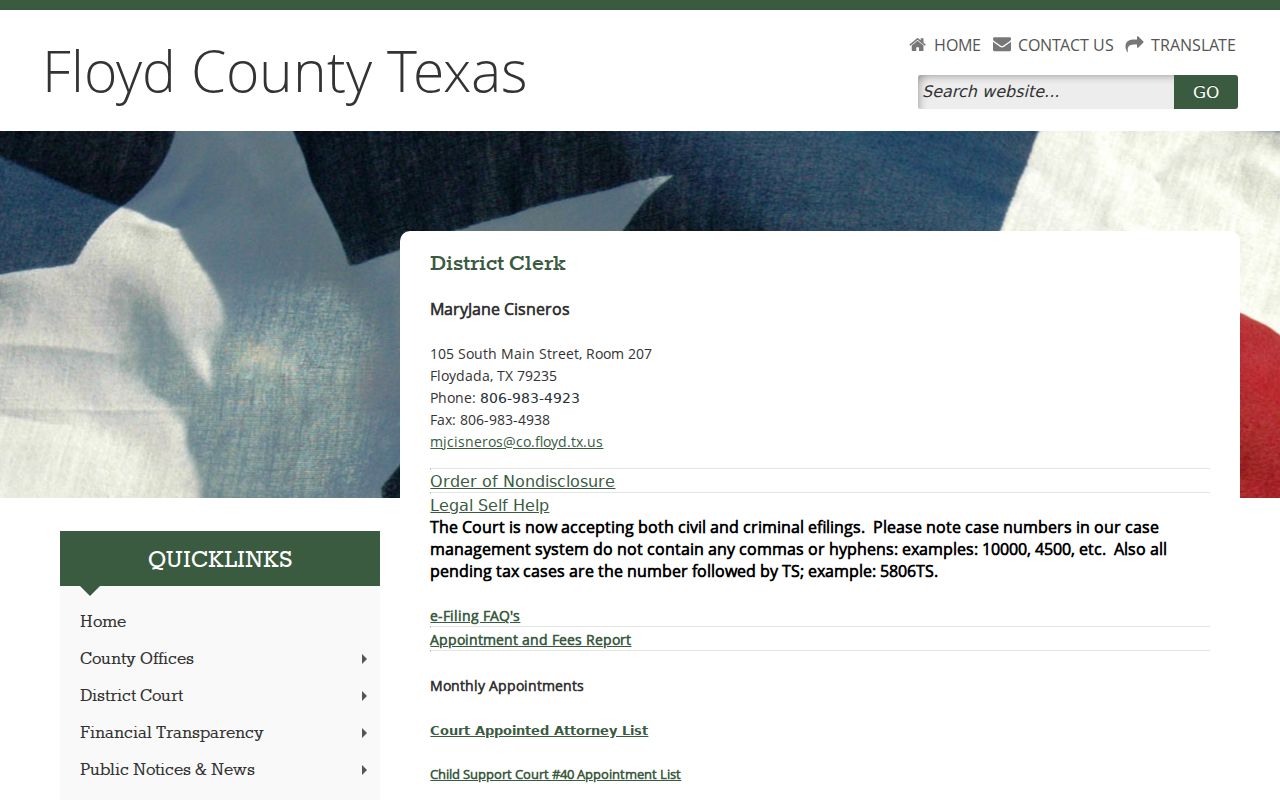
That office page is a contact point, not a public criminal-docket search screen, which is why direct confirmation remains important.
Criminal Case Stages on the Docket
A criminal docket usually starts when a charging instrument or complaint is filed in the court with authority over the offense. The register then grows as counsel appears, process is returned, settings are made, motions and orders are filed, and a plea or trial resolves the charge. Sentencing can be a later event. A reset is another procedural entry, not a dismissal.
Docket flow: Filing › Arraignment › Pretrial › Plea or Trial › Disposition › Sentencing
Floyd County Criminal Docket Activity
Texas Office of Court Administration figures provide context, but they cannot answer whether one case is pending. For fiscal year 2024, Floyd's district criminal row reported 43 cases at the start, 21 reactivated, 19 added, 27 disposed, 16 inactive, and 45 at end status. These are reporting fields across a year, not names, case numbers, or a live calendar.
Do not infer delay or outcome from those totals. Reactivations and inactive classifications affect the flow. Use the figures to understand court workload, then use the clerk's docket for the individual case.
Floyd County Criminal Docket Courts
The 110th District Court has Floyd criminal jurisdiction at the district level and also serves Briscoe, Dickens, and Motley counties. Its Floyd records remain with the Floyd District Clerk. The constitutional County Court has no separate county court at law beneath it; its records are maintained by the County Clerk. The precise misdemeanor assignment should be confirmed before requesting a file.
Justice of the Peace Precincts 1 and 4 share an office in Floydada, while Precincts 2 and 3 use the Lockney office. Floydada and Lockney Municipal Courts keep their own city-ordinance and fine-only offense records. An arrest record or DPS criminal-history record is a separate product and cannot replace the court docket.
The issuing court is especially important for a fine-only charge or traffic-related complaint. Floydada Municipal Court and the Precincts 1 and 4 JP office can share the same West Virginia Street address, yet their published phone numbers differ. The municipal court number is (806) 983-3615, while the JP office uses (806) 983-4911. In Lockney, Municipal Court uses (806) 652-2355 and the Precincts 2 and 3 JP office uses (806) 652-3622. Calling the right clerk avoids searching a separate docket that cannot contain the case.
When a Floyd County Criminal Docket Is Missing
First check the number format and the court. Then search re:SearchTX only as a second layer. Its official terms warn users to verify information, and Texas court guidance says there is no single universal trial-court portal. Coverage depends on the local system, date, case type, and access rules.
If the case should be in the 110th District Court, give the District Clerk the unpunctuated cause number and ask for the docket or a named filing. For a JP or city matter, contact the issuing court. For a constitutional County Court case, use the County Clerk. This routing check is usually more useful than repeating a broad name search.
Quick answer: No online result does not prove there is no Floyd County criminal case. Confirm the correct court and ask its clerk before drawing a conclusion.
Floyd County Criminal Docket Filing
eFileTexas is the submission channel for lawyers and parties who are authorized to file electronically. re:SearchTX is the related public electronic-record layer for covered material. They are not interchangeable. Floyd's local FAQ discusses filing codes, proposed orders, citations, service copies, and corrections after acceptance. Those directions tell a filer how to deliver a document; they do not create a universal public lookup.
A request to issue citation is also not a docket search. It is an optional filing service in the local workflow. Likewise, the state CARD database reports aggregate activity and court contacts, not charges or settings for a named case. For public case tracking, use the docket maintained by the actual court clerk. For a filed document, name the instrument and ask whether it is public and available as a plain or certified copy.
This distinction guards against two false conclusions: that an accepted upload must be instantly visible to everyone, or that a statewide search with no match proves the Floyd record does not exist. Neither follows from the documented systems.
Access Rules for Criminal Dockets
Many criminal docket entries are public, but access stops where law, court rule, or an order protects a record. Juvenile matters, sealed files, protected addresses, and confidential attachments may be absent or redacted. A public event line also does not make every document behind that line public. Ask the custodian whether the docket, a particular order, or a certified disposition is available.
Key rules:
Texas Judicial Branch access policy distinguishes administrative judicial records under Rule 12 from records filed in an adjudicative case.
Texas Family Code Chapter 58 restricts access to juvenile justice information.
Texas Family Code Section 85.026 protects specified address and contact information in protective-order records.